


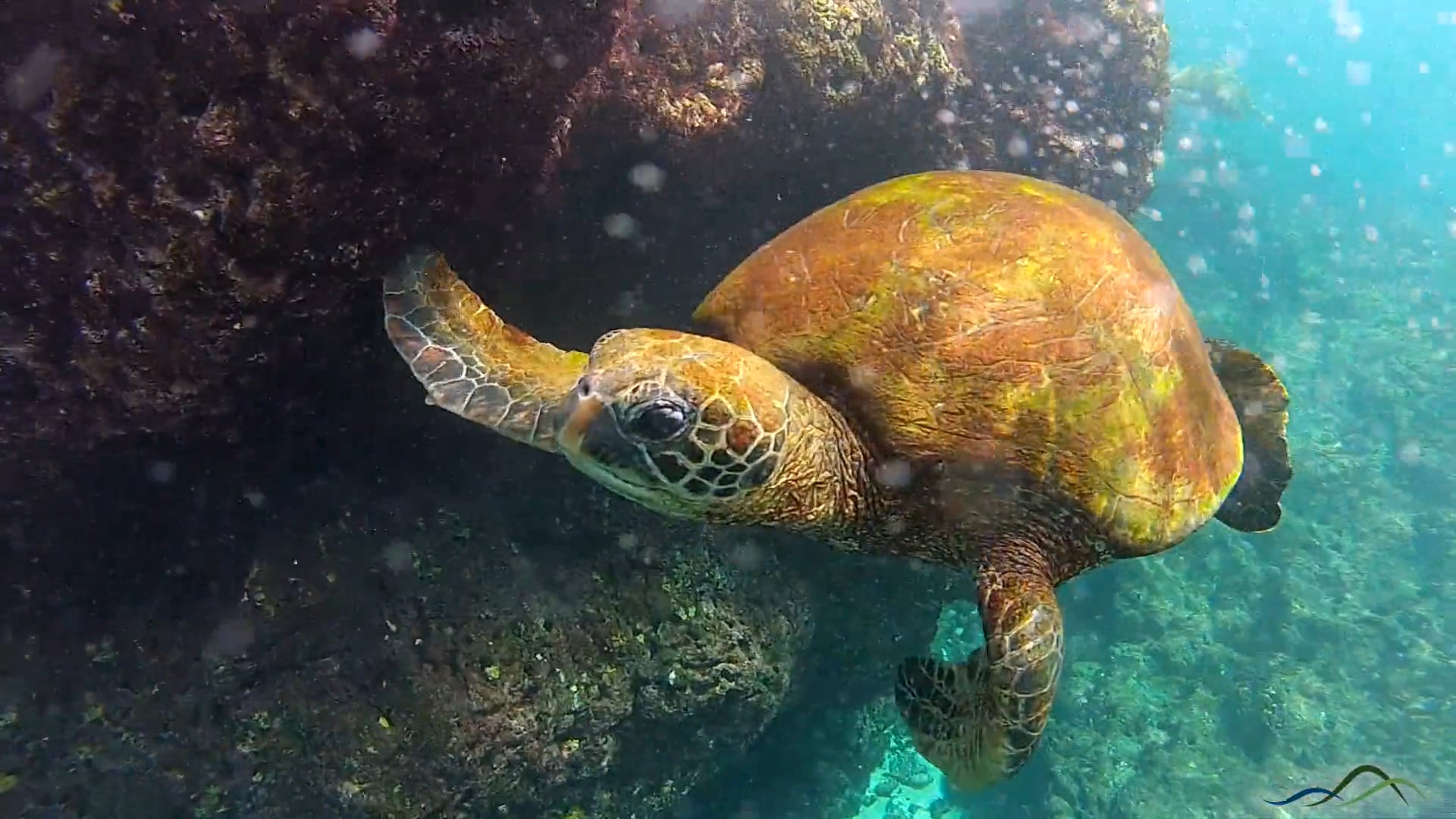
See a true Hawaiian local on your Kauai vacation. Our green sea turtles, known as honu, are older than the islands themselves and hold a special place in the minds and hearts of our people. During your stay in one of Parrish Kauai’s vacation rentals, you will have many opportunities to watch these graceful swimmers, whether from the shore or a few feet away while snorkeling.
What Makes the Honu Special in Hawaii?
To early Hawaiians, the honu were an important source of food, tools, and ornamentation. They also appear throughout Hawaiian art, signifying local respect for these peaceful creatures. Many households still treat the turtle as an aumakua, a family guardian.
Honu are the largest hard-shelled sea turtle, but they are named not for the color of their shell but for the color of their fat. They graze on limu and seagrass along the reef like sea cows, which is why you so often see them parked in the shallows chewing on algae. Adults reach 250 pounds or more and can live an estimated 60 to 70 years.
Are Hawaiian Green Sea Turtles Endangered?
After Western contact, Hawaiian green sea turtle numbers plummeted, and by the mid-1900s nesting had all but disappeared from the main Hawaiian Islands. Honu were listed as endangered in 1978.
The good news is that the protection worked. Following a status review, NOAA reclassified the Central North Pacific population as threatened rather than endangered in 2016, and the Hawaii population has been climbing for two decades. Threatened still means fully protected under federal law. It simply means the recovery is real.
Where Can You See Sea Turtles on Kauai?
There are plenty of great places to see sea turtles when in Kauai. On the South Shore, go to Brennecke Beach across from Nihi Kai Villas and watch them from the shore. The shoreline above Whalers Cove is another reliable spot. When you go snorkeling, look for them in the ocean off Lawai Beach, next to the famous Beach House restaurant.
During summer on the North Shore, you can snorkel with turtles at Tunnels Beach. Another option is around the Princeville community, when conditions allow.
Outside of the water, it is not uncommon to see turtles basking in the sun out on a sandy beach. This is normal behavior and not a sign of distress. A basking honu is resting and warming up, and it needs to be left alone.
Do Sea Turtles Nest on Kauai?
Mostly, they do not, and that fact surprises visitors. About 96 percent of all Hawaiian green sea turtles nest at Lalo, a small, low-lying atoll inside Papahanaumokuakea Marine National Monument. The turtles you see around Kauai are here to forage and bask, and most adults make that long migration northwest in spring to breed.
A female does not reproduce until she is 25 to 40 years old, and once she does, she returns to nest every two to five years and lays several clutches in a season. Small numbers of nests do turn up in the main islands, and that count has been rising. Sea turtle nesting season in Hawaii runs from mid-April into November and sometimes December.
What Kinds of Sea Turtles Live in Hawaii?
Several species of sea turtles call Hawaii home.
- Hawaiian green sea turtle (honu): The turtle you will actually see. Primarily vegetarian, 250 pounds or more, and capable of diving to considerable depth while foraging along the reef.
- Hawksbill (honu ea): Rare and far fewer in number than the Hawaiian green sea turtle, Hawksbill turtles are named for their beak-like mouth. Adults run about three feet in shell length and up to 250 pounds. Nesting is concentrated on Hawaii Island and Maui.
- Leatherback. The largest turtle in the world, reaching eight feet and 2,000 pounds. Leatherbacks feed on jellyfish in deep offshore waters and are the only sea turtle without a hard shell. You are not going to see one from the beach.
How Close Can You Get to a Sea Turtle?
NOAA asks people to stay at least 10 feet away from sea turtles, on land and in the water. Limit your viewing to a few minutes and use your camera’s zoom rather than closing the distance.
Riding, touching, or chasing a sea turtle is ilegal, and the penalties under federal law are serious. On our Kauai beaches, never try to push a turtle back into the water or pour water on it. Allow a clear path and never block access to the land or the sea. Keep wild turtles wild. In the ocean, give them room to surface and breathe, and resist the temptation to follow one out too far from shore.
What Should You Do If a Turtle Is in Trouble?
If you find a sea turtle that is injured, entangled in fishing gear, or clearly in distress, call the 24-hour NOAA Marine Wildlife Hotline at 888-256-9840. To report harassment or suspicious activity, call DLNR enforcement at 808-643-3567 or use the DLNRTip app.
You can also help science from your beach chair. If you spot a honu with white letters and numbers etched on its shell, report it to NOAA’s Honu Count project. Those markings come from nesting turtles at Lalo, and public sightings help researchers track where they go afterward.
Stay Near Kauai’s Beaches
The easiest way to see honu is to stay somewhere you can check the water every morning. Whether you are interested in staying on the South Shore or North Shore, Parrish Kauai’s collection of vacation rentals has you covered. Enjoy fully equipped kitchens, private lanais, and close proximity to Kauai’s top attractions, including beaches where you can spot honu. When you are ready to book, check availability online. For assistance, call us at 800-318-8384.